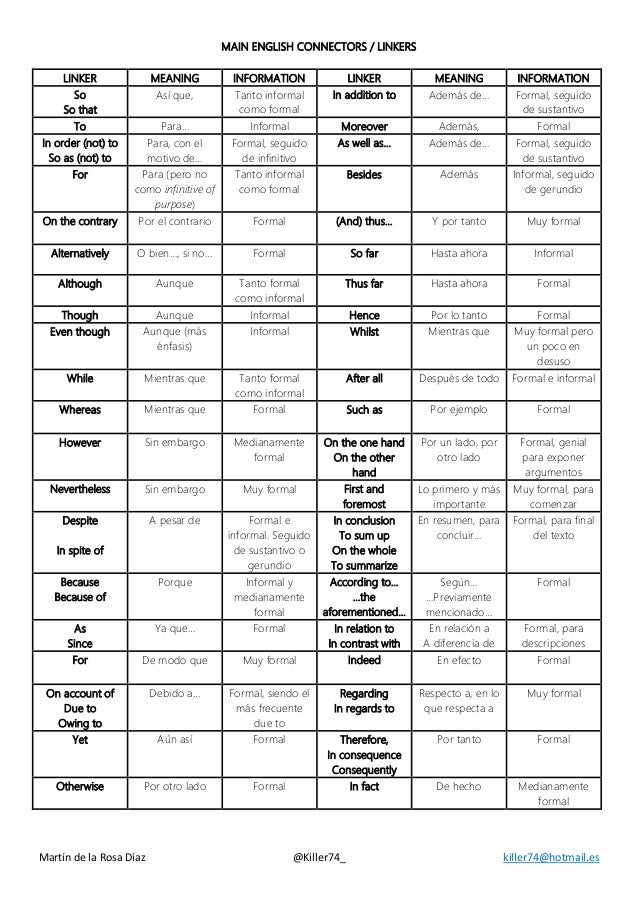
Below you will find a chart with some of the most frequently used linkers and transition expressions, which you are encouraged to use instead of „and‟, „but‟ or „so‟ whenever possible. Notice that free standing linkers are followed by a comma, whereas conjunctions and prepositional phrases have a different structure.
At the end of the post w¡you will find the solutions of all the exercices.
1. Fill in the gaps with a linker from the box. Notice that more than one answer is possible.
a. I‟d like to find a better job. _______________, I don‟t have much experience.
b. _______________ the weather was fine we didn‟t go to the beach.
c. We need clear guidelines. _______________, we need well laid out activities.
d. I revised for my exams successfully and I met my deadlines. _______________, I managed to pass all my subjects.
e. Car manufacturers have to make impressively powerful cars while, _______________, governments are asking for more “green” cars that pollute less.
f. We were unable to get funding and had to abandon the project _______________.
g. I didn‟t find the session interesting. _______________, I got bored to tears.
2. Fill in each blank with a word from the box. Each word can only be used once. You need to pay attention to both meaning and grammatical function. There is one extra word.
despite
however
|
furthermore
unless
|
because of
since
|
if
although
|
(1) Although it is clear that every effort has been made to clarify the test‟s instructions, many students will fail to understand them. So, (2) __________________ the basic simplicity of the test itself, many students fail. (3) ____________________ the high failure rate, an even simpler test is being devised. (4) ___________________ that does not work, perhaps we should give up testing in the present way altogether. (5) ____________________ we find some way of testing the students satisfactorily, we will have to deal with complaints from both students and parents. (6) ______________________, the lack of an adequate test would probably lead to loss of government support. (7) ______________________ we cannot afford to lose this support, we must absolutely make sure that the new test is effective.
Reading Comprehension: Answer the questions based on the preceding text.
_____1.
According to the passage, the current test does not work because of
a. its basic simplicity.
b. the difficult instructions.
c. the failure rate.
|
_____2.
How does the writer describe the current test?
a. Simple
b. Clear
c. Satisfactory
_____3.
Why is an effective test necessary
a. To keep things simple.
b. To keep students working.
c. To keep government support.
|
KEY
EX. 1
a-I‟d like to find a better job. However,/Nevertheless, I don‟t have much experience.
b-Although/Though/Even though, the weather was fine we didn‟t go to the beach.
c- We need clear guidelines. Furthermore,/In addition,/Moreover, we need well laid out activities.
d- I revised for my exams successfully and I met my deadlines. Therefore,/As a result, I managed to pass all my subjects.
e- Car manufacturers have to make impressively powerful cars while, on the other hand,governments are asking for more “green” cars that pollute less.
f- We were unable to get funding and had to abandon the project as a result.
g- I didn‟t find the session interesting. On the contrary, I got bored to tears.
EX 2
(1) Although it is clear that every effort has been made to clarify the test‟s instructions, many students will fail to understand them. So, (2) ____despite_______ the basic simplicity of the test itself, many students fail. (3) ____Because of_______ the high failure rate, an even simpler test is being devised. (4) _______If__________ that does not work, perhaps we should give up testing in the present way altogether. (5) _____Unless_________ we find some way of testing the students satisfactorily, we will have to deal with complaints from both students and parents. (6) _____Furthermore______, the lack of an adequate test would probably lead to loss of government support. (7) _______Since__________ we cannot afford to lose this support, we must absolutely make sure that the new test is effective.
Reading comprehension:
b-c-a