Mostrando entradas con la etiqueta Numbers. Mostrar todas las entradas

other revision 1st Term.- Vocabulary

The Family

Click on the links below to practise your vocabulary:

Contries and Nationalities
Classroom Objects
My family 

Click on the following links to practise your grammar:

Demonstratives
Pronouns and possessives
Saxon Genitive


Click on the following links to practise telling the time.

What's the time?
What time is it?

ORDINAL NUMBERS

Ordinal Numbers

Para decir las fechas en inglés, necesitamos conocer los números ordinales. Aquí os adjunto un pequeño resumen que puede resultar útil.

                   Table of Ordinal Numbers
Ordinal Numbers from 1 through 90
  1
st
first
11
th
eleventh
21
st
twenty-first
31
st
thirty-first
2
nd
second
12
th
twelfth
22
nd
twenty-second
40
th
fortieth
3
rd
third
13
th
thirteenth
23
rd
twenty-third
50
th
fiftieth
4
th
fourth
14
th
fourteenth
24
th
twenty-fourth
60
th
sixtieth
5
th
fifth
15
th
fifteenth
25
th
twenty-fifth
70
th
seventieth
6
th
sixth
16
th
sixteenth
26
th
twenty-sixth
80
th
eightieth
7
th
seventh
17
th
seventeenth
27
th
twenty-seventh
90
th
ninetieth
8
th
eighth
18
th
eighteenth
28
th
twenty-eighth


9
th
ninth
19
th
nineteenth
29
th
twenty-ninth


10
th
tenth
20
th
twentieth
30
th
thirtieth


Formación
Se añade -th   a los números cardinales
§  four - fourth
     eleven - eleventh
Excepciones:
§  one - first
§  two - second
§  three - third
§  five - fifth
§  eight - eighth
§  nine – ninth
§  .twelve - twelfth


How many names does zero have?

One of the things my students find incredible about the English language is that a figure like zero should have so many different names. Have you ever come to think about it? I don’t know if this happens in other languages, but at least it doesn’t happen in Spanish...
It’s not only that it has many names, but also they are used in different contexts. Let’s have a look:
  • Zero. This word derives from the Arab word sifr, meaning “empty”. It is mainly used in mathematics: counting, percentages, decimals..., and also when talking about the temperature: 0º C (zero degrees Celsius)
  • Nought or naught  in American English is an older word for zero. It comes from Old English nowiht, meaning “nothing”. Today, its use is very similar to that of zero. He wrote a cheque with a figure containing five noughts. The famous game tic-tac-toe in which the players try to make a line of three noughts or crosses between vertical and horizontal lines is also called nougths and crosses.
Noughts and crosses
Image in http://www.flickr.com/photos/49719028@N00/103958463 

  • Nil comes from Latin nihil , meaning “nothing”. It is used in sports such as football, especially in British English. They won by three goals to nil.
  • O (often spelled oh) is used when giving telephone numbers and addresses, talking about time and also in the designation of James Bond: 007 (double o seven). It’s 4:09 (four oh nine). I live at 207 Melbourne Avenue (two oh seven).
http://fondoswall.blogspot.com

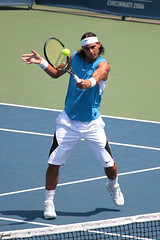
  • Love is used in tennis. It’s origin is difficult to trace, but it’s been used to mean zero in this sport since the 18th century. Nadal is winning 40-0 (forty love)
Rafael Nadal
Image in: http://www.flickr.com/photos/66727626@N00/362013007


  • Duck is zero in cricket. The term is short for “duck’s egg”, which is supposed to look like the shape of the number “0”. Jones was dismissed for a duck in the first-innings.
  • Zilch is slang for zero or nothing. The U.S. personal-savings rate has risen from zilch last year to 3 percent of disposable income.
  • Zip is American slang for zero. I received zip for money after doing the job for them.

Do you know any other name for zero?

In the following video we will hear how to say different numbers, including some of the names of zero

Numbers

http://www.languageguide.org/english/numbers/

Exercises

Let's review : 

  • WRITE NUMBERS
Exercise 1    Exercise 2 
  • DATE
Exercise 1    Exercise 2    Exercise 3 
  • PRONOUNS: SUBJECT
Exercise 1    Exercise 2
  • PRONOUNS: OBJECT
Exercise 1    Exercise 2
  • POSSESSIVES